


Bearings are one of the cleanest ways to express a long-term view on robotics because they sit beneath nearly every architecture choice in the category. Whether the winning robot form factor is humanoid, wheeled, warehouse-specific, drone-based, or fully modular, moving systems still require bearings to reduce friction, support shafts, manage loads, and preserve precision over time. That makes bearings less of a speculative bet on a single robot design and more of an infrastructure play on the broader automation stack.
The narrative matters because robotics investing is often dominated by visible names: robot OEMs, AI model providers, sensor companies, and battery platforms. Bearings sit in a less glamorous but more durable layer of the stack. If robotics adoption scales over decades rather than quarters, component categories with low substitution risk, broad platform exposure, and repeat demand across maintenance cycles may end up offering some of the most resilient economics in the ecosystem. [morganstanley]
The core investment narrative
The bullish case for bearings in robotics is not that they are revolutionary. It is that they are indispensable. OpenAI’s U.S. manufacturing RFP for hardware explicitly lists precision bearings, ball, roller, and harmonic, among the critical robotics components for domestic capacity building, alongside actuators, harmonic drives, motors, power electronics, and permanent magnets. When a frontier AI company planning long-term robotics manufacturing highlights bearings as a strategic bottleneck, it reinforces the idea that these parts are foundational rather than incidental.
This creates an important investment asymmetry. Many robotics categories face design risk: one actuator type can lose to another, one sensor suite can be displaced, and one robot architecture can fail to commercialize at scale. Bearings are different because they tend to persist across formats. Their role is mechanical, not cosmetic. As long as robots contain rotating joints, motors, wheels, gearboxes, or articulated motion systems, they need bearing solutions tuned for speed, load, heat, vibration, compactness, and durability.
In that sense, bearings are a picks-and-shovels exposure to robotics. They do not require predicting which single OEM wins the humanoid race. They benefit from the simple fact that if the installed base of robots expands, the unit demand for bearings should rise with it, and often rise faster as robot designs become more complex and motion-dense.
Why the market could scale dramatically
Morgan Stanley estimates that the humanoid robot market could reach $5 trillion by 2050, with more than 1 billion humanoids in use and roughly 930 million of them deployed in industrial and commercial environments rather than homes. Even if only a fraction of that vision materializes, the implications for motion components are substantial because robots are not monolithic products; they are assemblies of repeated subcomponents. Every added joint, actuator, wheel, gearbox, or end-effector creates additional demand for high-performance motion hardware.
That is the mechanism behind claims that robot bearing demand could expand far faster than the broader bearings market. A simple drone may require roughly 8 to 12 bearings, while a humanoid platform can require 70 or more depending on joint architecture, hand design, drivetrain layout, and redundancy requirements. The economic meaning of that difference is easy to miss: a robot category shift toward higher degrees of freedom multiplies component content per unit. Investors are not only underwriting more robots; they are underwriting more bearings per robot.
The same dynamic helps explain why the market opportunity is not linear. Complexity compounds content. As robots move from fixed industrial arms into mobile, collaborative, warehouse, logistics, inspection, medical, agricultural, and humanoid formats, the bearing requirement expands not only in count but also in performance specification. More moving parts create more failure points, and more failure points increase the value of precision, tolerance control, and long service life.
Content scales with robot complexity
A bearing is easy to overlook because it is small relative to the systems around it. But robotics is a game of stacked precision. Motors need bearings. Gearboxes need bearings. Wheels need bearings. Rotating joints, arms, wrists, fingers, gimbals, and drone propellers all depend on them. This makes bearing demand a function of both unit shipments and mechanical sophistication.
The relationship between degrees of freedom and bearing intensity is central to the narrative. A simple four-rotor drone can operate with a relatively low bearing count because motion is concentrated in a few spinning assemblies. A humanoid robot is entirely different: shoulders, elbows, wrists, hips, knees, ankles, neck, hands, and mobility subsystems all introduce multiple motion axes and therefore multiple bearing locations. If robotics shifts toward systems designed to mimic human dexterity or navigate unstructured environments, the content opportunity for bearings rises materially.
Pricing also varies widely by application. Commodity bearings can cost under $1, while specialized precision bearings can run to $100 or more depending on tolerances, materials, operating environment, heat resistance, miniaturization, and lifecycle demands. That matters because robotics growth does not simply expand volumes; it can mix demand toward higher-value products. In other words, bearing exposure to robotics is not only a units story. It can also become a margin and product-mix story.
Architecture-agnostic demand is the strategic advantage
One of the strongest parts of the bearings thesis is that it is architecture-agnostic. The market still does not know whether the dominant robotics form factor over the next 10 to 20 years will be humanoids, task-specific robots, drones, autonomous mobile robots, or hybrid systems. Morgan Stanley itself notes that adoption should be slow until the mid-2030s and then accelerate later, with commercial and industrial use far outpacing household penetration. That uncertainty creates risk for investors trying to pick single winners at the top of the stack.
Bearings reduce that problem. They are not a bet that one OEM wins. They are a bet that motion wins. Whether the future robot is a warehouse picker, elder-care assistant, surgical support platform, agricultural rover, delivery drone, or factory humanoid, the machine still needs rotational control and load management. In capital markets terms, that makes bearings closer to a common denominator than a differentiated endpoint product.
This is also why substitution risk appears low. There are alternative bearing types, form factors, and engineering approaches, but not a credible world in which moving machines eliminate the need for bearing-like functionality altogether. Some robots may use more harmonic or crossed-roller formats, others may optimize for ball or roller bearings, but the mechanical need remains persistent. That lowers the risk of outright obsolescence relative to categories tied to one sensing modality, one battery chemistry, or one specific AI software stack.
Supply-chain structure supports the thesis
The global bearing industry is relatively consolidated. Major producers include SKF, Schaeffler, NSK, NTN, JTEKT, C&U, and Timken, with the largest players spanning Europe, Japan, the U.S., and China. Market-share estimates vary by methodology, but the industry is generally characterized by a concentrated upper tier and significant Asian manufacturing depth, with Chinese firms playing an increasingly important role. That industrial structure matters for robotics because it means scaling robot production is partly a question of whether high-precision component capacity exists in the right geographies and at the right quality levels. [morganstanley]
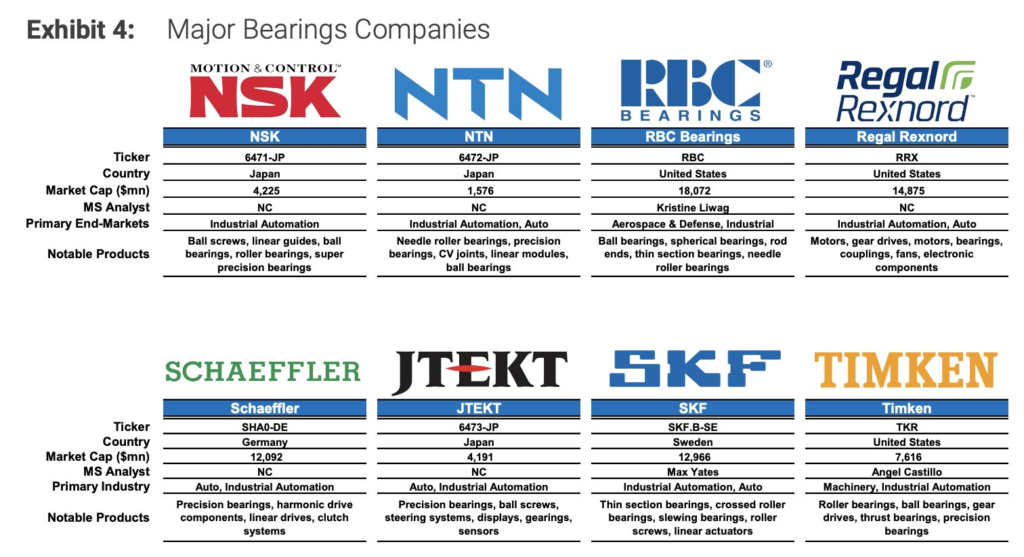
Morgan Stanley’s analysis of humanoids highlights that the U.S. has relatively few domestic alternatives for many key components and that China maintains major supply-chain strengths across robotics hardware. OpenAI’s RFP points in the same direction by explicitly seeking U.S.-based manufacturing capacity for robotics components, including bearings, motors, and gear systems. Put differently, bearings are not just a demand story. They are becoming a strategic supply-chain story tied to reshoring, resilience, and industrial policy. [OpenAI]
That matters because when critical components move from being commoditized to being designated as strategic, the market begins to value manufacturing capability differently. Domestic capacity, quality assurance, and application-specific engineering can command a premium when buyers are trying to reduce geopolitical dependence or qualify multiple suppliers for scale production.
Where robotics fits into the current market mix
Today, the global bearings market is still dominated by legacy end markets rather than robotics. Industrial equipment OEMs, automotive demand, and distribution channels remain the core volume drivers, with industrial and vehicle applications accounting for the bulk of consumption. That is important because it means robotics is not yet the earnings driver for most bearing companies. The theme is early.
However, early does not mean irrelevant. It means robotics can function as an incremental growth leg layered on top of a large existing industry base. That profile can be attractive for investors because it pairs cyclical industrial exposure with a secular automation option. Rather than funding pre-revenue robotics startups directly, investors may be able to gain exposure through component suppliers whose legacy businesses support current cash flows while robotics demand compounds in the background.
This combination of mature base demand and emerging robotics upside is one reason the bearings narrative deserves attention. It offers a bridge between old-economy manufacturing and next-generation automation. In market terms, that often creates underappreciated rerating potential once investors begin to separate “generic industrial supplier” from “critical motion-enablement platform.”
What the narrative is really saying
The deepest narrative behind bearings is not about parts count alone. It is about where durable value tends to accumulate when a new hardware category scales. Early in technology cycles, capital chases the visible finished product. Over time, value often migrates toward bottleneck components, manufacturing expertise, and reliability-critical subsystems. Bearings fit that pattern because they sit at the intersection of necessity, repetition, and performance.
The robotics story is often told as an AI story, but real-world robotics is always an AI-plus-mechanics story. Intelligence without precision motion is software without embodiment. A robot may have state-of-the-art models, but if its joints wear prematurely, if its actuators vibrate, or if its mobility system cannot hold tolerances over time, the robot fails commercially. Bearings are one of the core enablers that convert intelligence into durable physical action.
This is why the category can be misunderstood. Bearings sound boring, and boring components are often where the strongest long-duration industrial economics emerge. They win when markets reward reliability, certification, replacement cycles, engineering know-how, and entrenched supplier relationships. In robotics, those characteristics may matter more than headline excitement.
Risks to the thesis
The thesis is strong, but it is not risk-free. The first risk is timing. Morgan Stanley’s own view is that humanoid adoption remains relatively slow until the mid-2030s, which means bearing suppliers may not see immediate robotics-driven revenue inflection even if the long-term opportunity is large. Investors could be directionally right and still early.
The second risk is that robotics demand may initially remain too small relative to industrial and automotive end markets to move overall company earnings. A bearing supplier can be strategically important to robotics without that theme being financially material in the near term. That can delay valuation recognition.
The third risk is competition and pricing pressure. While high-specification bearings can command strong margins, many applications are still cost-sensitive. If robot OEMs prioritize aggressive cost reduction at scale, some categories may face commoditization pressure even as volumes rise. Not every bearing supplier will capture the same value.
The fourth risk is geographic concentration. If China continues to strengthen its lead in robotics supply chains, non-Chinese suppliers may face cost disadvantages, while Chinese suppliers could face export restrictions, reshoring pressure, or tariff-related friction depending on policy developments. Supply-chain resilience is a tailwind for some firms but also a strategic complexity for the sector as a whole.
Strategic conclusion
Bearings represent one of the more compelling second-order ways to think about robotics exposure. They are easy to underestimate because they are not the headline technology, yet they are foundational to the physical operation of nearly every robot architecture under development today. That combination—indispensability, architecture-agnostic demand, low obsolescence risk, and rising content intensity as robots become more complex—makes them a credible long-term picks-and-shovels thesis.
The broader narrative is that robotics will not be built only on AI models and charismatic OEM brands. It will be built on the physical supply chain that makes reliable motion possible at scale. Bearings are part of that substrate. If humanoids, autonomous systems, and industrial robots proliferate over the coming decades anywhere close to the path imagined by Morgan Stanley, then the humble bearing may prove to be one of the most important non-obvious beneficiaries of the entire automation wave.
